
Clients We've Worked With...





Wasp and Hornet Control in Victorville, CA
Wasp and hornet activity in Victorville peaks in late summer, when colonies reach their largest size and become most aggressive. The dry heat of the High Desert accelerates colony growth from spring through August, and by late summer a paper wasp nest that started as a small cluster under an eave can hold hundreds of workers. Safe T Spray Pest Control handles wasp and hornet control in Victorville, CA 92394 and the surrounding High Desert communities. We offer free pest inspections across the High Desert.
Signs You Need a Wasp Exterminator in Victorville
If you notice any of these signs, call before the colony grows larger.
A visible nest near doors, windows, or walkways: Nests in high-traffic areas create a sting risk because wasps defend their colony when disturbed.
Stings without seeing a nest: Yellow jackets often build underground nests, so unexplained stings may indicate a hidden colony nearby.
Buzzing inside walls or ceilings: Yellow jackets can nest in wall voids, attics, and roofline gaps where colonies grow out of sight.
A nest getting larger each week: Growing paper wasp nests indicate an active colony that will continue expanding without treatment.
Heavy activity around trash, food, or fruit trees: Increased wasp activity in late summer often means a nearby colony has reached peak size.
Late summer is the riskiest time for wasp problems because colonies are largest and workers become more aggressive. A disturbed nest can send multiple wasps out to defend the colony.
Wasps and Hornets Common in the Victorville Area
Three species account for nearly all wasp and hornet calls in the High Desert. Knowing which one you are dealing with changes how it needs to be treated.
Paper Wasps
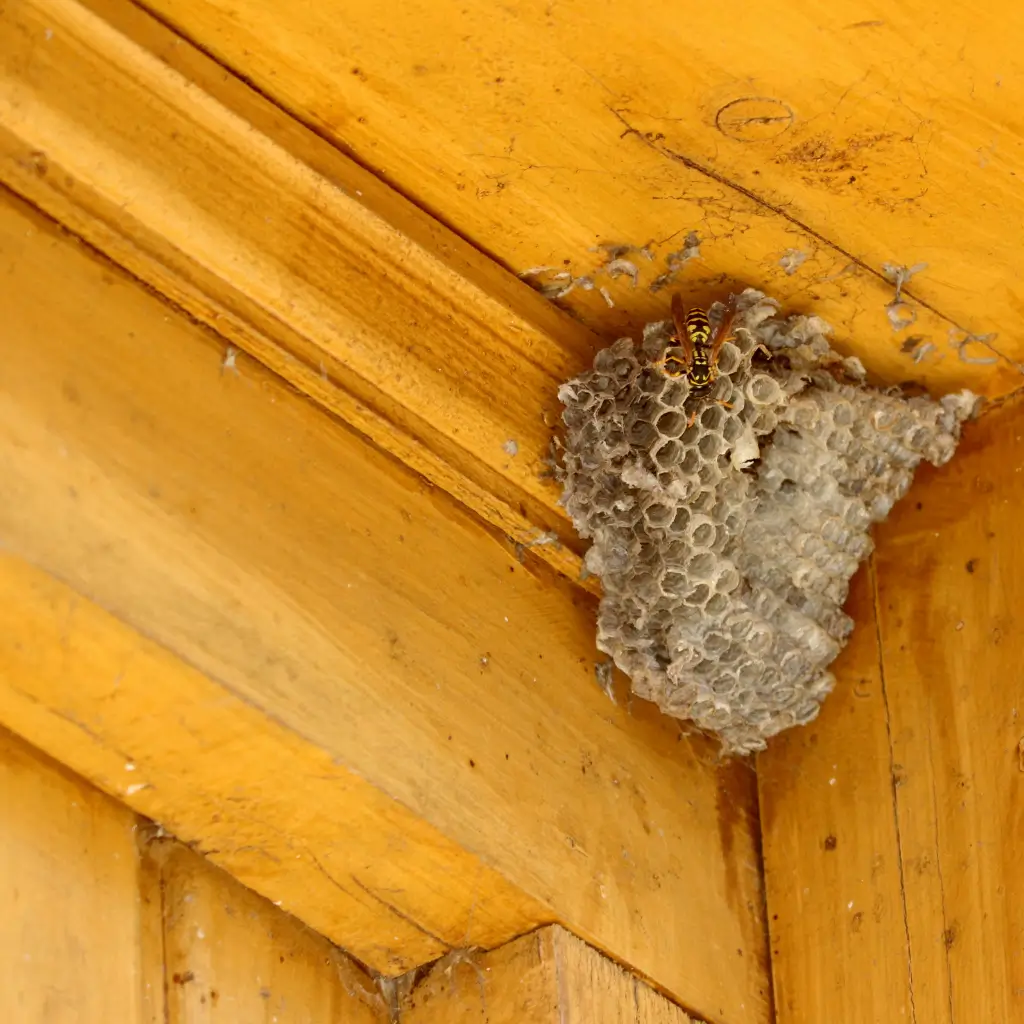
Paper wasps are the most visible wasp in Victorville. They build open, umbrella-shaped nests made from chewed wood fiber, and they attach them under eaves, patio covers, roof overhangs, utility meter boxes, and inside block wall openings. According to the UC IPM Pest Notes on Yellowjackets and Other Social Wasps, paper wasps in California include species such as Polistes aurifer and Polistes dominulus, both of which are common in Southern California. They are less aggressive than yellow jackets but will sting repeatedly if the nest is disturbed.
Yellow Jackets
Yellow jackets are one of the most dangerous stinging insects on High Desert properties. The western yellowjacket (Vespula pensylvanica) nests underground or in wall voids and is often mistaken for a bee. They are attracted to meat, sugar, outdoor food, and trash cans in late summer. Disturbing a nest can trigger an aggressive colony response.
Mud Daubers
Mud daubers are solitary wasps that build small mud tubes on walls, eaves, and sheltered surfaces. They are not social insects and do not live in colonies. A single mud dauber builds a nest, stocks it with paralyzed spiders as food for its larvae, and leaves. They rarely sting and are not a threat to people. If you have mud tubes on the side of your home, they are a cosmetic issue, not a pest emergency.
Where Wasps and Hornets Build Nests on High Desert Properties
Wasps and hornets in Victorville often build nests in protected areas around homes and businesses. These are the first places professionals check during an inspection.
Eaves and roofline overhangs: Paper wasps commonly build nests under eaves, patio covers, and roof edges because these areas provide shade and protection.
Wall voids and attic entry points: Yellow jackets enter through roof gaps, fascia openings, and small exterior cracks, allowing hidden colonies to grow inside walls or attics.
Ground burrows in yards: Underground yellow jacket nests are common in dry High Desert soil and can be difficult to spot until activity increases.
Utility boxes and electrical enclosures: Dark, enclosed spaces provide shelter for paper wasps and yellow jackets.
Roof vents, soffits, and outdoor covers: Damaged vents, patio furniture, and BBQ covers can create hidden nesting areas that go unnoticed.
Wasp and Hornet Control for Homes and Businesses in Victorville
Wasp and hornet nests appear on every type of property. Our service is adjusted for the building we are treating.
Wall void and attic nests require treatment from inside the structure in some cases. We locate the colony, treat the void, and monitor the result before closing any access points. Sealing an active wall void without treating the colony first forces wasps to find another exit, sometimes into the living space. Our interior pest control services address additional pest activity found inside the home as part of the same visit.
Eaves, rooflines, patio covers, and exterior utility areas are where most wasp nests on High Desert properties appear. We treat active nests and inspect the full exterior perimeter for nesting sites that are not yet active. See how we help protect the outside of your property from pest pressure.
New construction leaves exposed wood framing, open block cells, and unfinished utility penetrations that paper wasps use as early-season nesting sites. Treating these areas before the building is occupied prevents established colonies from forming in hard-to-reach spaces. Our new construction pest control covers these spaces as part of a broader property protection plan.
A wasp nest near a building entrance or loading area creates a direct safety risk for employees and visitors. We schedule inspections and treatments around business hours to minimize disruption. Businesses can explore our office pest control services for broader ongoing pest protection.
Warehouses, retail properties, and large commercial sites have extensive rooflines, loading areas, and exterior utility zones where wasps nest consistently through the summer. We build treatment plans around the full footprint of the property. Our commercial pest control services in Victorville provide broader protection for these types of properties.
A nest near a shared entrance, stairwell, or courtyard affects every resident in the building. We locate all active nests across the property and treat them together rather than responding to individual unit complaints one at a time. Our apartment complex pest control services are designed for multi-unit properties that need coordinated pest management.
Our Wasp and Hornet Control Process in Victorville
Wasp and hornet treatment follows a different sequence from most pest control jobs. Our wasp extermination process starts with identifying the species and locating the active nest before treatment begins.
Step 1: Species and Nest Identification
We identify the species and locate every active nest on the property, including ground nests and wall void nests that are not immediately visible. Treatment approach, product choice, and timing all depend on what we find. Treating a ground nest the same way as an aerial paper wasp nest produces poor results.
Step 2: Nest Treatment
We apply professional-grade product directly to the nest entrance and structure. For aerial nests, treatment is timed for late evening when foraging workers have returned and the colony is concentrated in the nest. For ground nests, product is applied into the entrance to reach the colony below. Wall void nests require targeted application into the void to reach the colony without driving workers into the living space.
Step 3: Confirmed Die-Off Before Removal
We do not remove an aerial nest immediately after treatment. Workers that were foraging away from the nest at the time of treatment return afterward and contact the treated nest. Removing the nest too early eliminates that contact point and leaves returning workers without a target, which increases the risk of aggression. We confirm die-off before removal.
Step 4: Nest Removal and Site Treatment
After the colony is confirmed dead, we remove the nest and treat the attachment site. Old nest material and residual pheromones can attract new queens looking for nesting sites in the following season. Removing the nest and treating the site reduces that risk.
Step 5: Entry Point and Prevention Recommendations
We note the conditions that allowed the nest to develop and provide specific recommendations for your property. Open weep holes, damaged vent covers, and gaps in the fascia are the most common entry points for recurring yellow jacket problems on High Desert homes.
Why Victorville Property Owners Choose Safe T Spray
Safe T Spray Pest Control has served homes and businesses throughout Victorville and the High Desert for more than a decade.
Experienced Technicians: Certified experts with knowledge of pests and safe, effective treatments.
Transparent Pricing: Clear estimates with honest advice and no-pressure service.
Flexible Service Plans: Monthly or one-time pest control programs tailored to your needs.
Safety Focused: Proper equipment, trained staff, and strict safety standards.
Reliable Scheduling: We show up when we say we will and complete every job efficiently.
Clean Worksites: We leave your property safe, clean, and pest-free every time.
How Much Does Wasp and Hornet Control Cost in Victorville, CA?
Wasp and hornet control in Victorville typically costs between $100 and $350 for a standard residential property. The final cost depends on the nest type, location, colony size, and treatment difficulty. An easy-to-reach paper wasp nest under an eave usually costs less than a yellow jacket colony inside a wall void or an underground nest that requires more targeted treatment.
Safe T Spray Pest Control offers free inspections in Victorville and the High Desert. We identify the nest location, determine the level of activity, and recommend the right treatment before providing a cost estimate. Call (323) 328-6435 to learn what your wasp or hornet removal requires.
See what customers say about us
Henry was very helpfully and professional. I called him at work for a wasp problem and before I could even get home from work they were gone. Now that’s service. Thank you again Henry.


He was on time and very professional and thorough. Addressed everything and listened to my concerns and took care of them. Very nice and personable. No problems at all. I will be keeping him as my new bug man. Great prices! Thank you Henry


I can’t recommend this exterminator highly enough! From the moment I called, he was professional, responsive, and incredibly knowledgeable. He arrived on time, did a thorough inspection, and quickly identified the root of the problem. Not only did he handle the issue efficiently, but he also explained everything in detail and provided tips to prevent future infestations. You can tell he takes real pride in his work—friendly, respectful, and clearly experienced. Within days, the difference was night and day. If you’re in need of reliable, high-quality pest control, this is the company to call. Outstanding service from start to finish!

Very thorough with the application, I've also had mice on a couple occasions and they were caught on the first night. Would absolutely recommend calling them with any issues you're wanting to get taken care of.

Great services good communication. He’s the best person in town thank you, Henry.

Great company! Ive been using this service for about 2 years now. Technician always shows up on time and does a great job! All bugs since the start of service have been eliminated, thx!

I’ve been having water bug issues so I tried Safe T Spray and had great results. Took care of my problem and got to root of it all. Good prices and I will be having this business come back and take care of any future pest problems. Thanks again

Best customer service all ways on time with appointments. Gets the job done in a timely matter. Highly recommend Por your pest control needs.

Always on time, great customer service and whatever is in that spray bottle keeps all the bugs from attacking my home. Prices are great…

I have used Safe Spray for the past seven years and plan on keeping Henry for many years to come

Very professional..always clean and on time..would recommend to anyone trying to keep those nasty bugs away ..thank you for your help..

Great work always on time goes over and beyond to make sure the job done right. We thank you so much at BlossomingMindsFamilyDaycare

Henry is the best, I’ve been using Henry’s pest service’s for many years. 🥰

Excellent service . Henry is very responsible, cordial and friendly.

Great pest control company. Highly recommended.

Wasp and Hornet Control Service Areas Near Victorville, CA
We provide wasp extermination and hornet removal services across Victorville and the surrounding High Desert communities:
Frequently Asked Questions
How do I know if wasps are nesting inside my wall?
Look for buzzing sounds inside the wall during the day, yellow jackets entering and exiting the same small gap in the roofline or stucco, and wasp activity near one exterior spot with no visible aerial nest. If you see any of these, the colony is likely inside the wall. Do not seal the gap before the colony is treated or wasps will push into the living space to find another exit.
When are wasps most active in the High Desert?
Wasps in Victorville and the High Desert are most dangerous from late July through September. That is when yellow jacket colonies reach peak size and workers shift from hunting insects to scavenging for food around trash cans and outdoor eating areas. The High Desert's extended heat season keeps colonies active longer than in cooler parts of California.
Why do wasps keep coming back to the same spot on my house?
Wasps return to the same spot because residual pheromones from the previous colony remain on the surface after the nest is removed. A new queen can detect those signals the following spring and build in the same location. Treating the attachment site after removal and closing the gap or vent that made the spot attractive in the first place is what stops the repeat.
What happens if you seal a wall void with wasps still inside?
Sealing an active wall void entry point forces the colony to find another exit, which is almost always into the interior of the home. Workers push through drywall gaps, electrical outlets, and ceiling fixtures when they cannot get out the way they came in. Always treat the colony first, confirm die-off, and then seal the opening.
Is it safe to remove a wasp nest yourself in Victorville?
Removing a wasp nest yourself is only low risk for a very small, early-season paper wasp nest located away from any entrance or foot traffic. A yellow jacket nest in a wall void or underground is not safely handled without professional equipment. Any nest near a doorway, larger than a softball, or inside a wall or the ground should be treated by a professional.
How long does wasp and hornet treatment take to work?
Aerial paper wasp nests in Victorville typically show die-off within 24 to 48 hours of treatment. Ground nests and wall void nests take longer because the product needs time to reach the full depth of the colony. We do not remove the nest on the same visit as treatment. We confirm die-off first, then return to remove it.
Call a Wasp Exterminator in Victorville for Safe Nest Removal
If you have found a nest near a doorway, been stung without seeing an obvious nest, or heard activity inside a wall, call Safe T Spray Pest Control. We serve Victorville, CA 92394 and surrounding High Desert communities across San Bernardino County. Call (323) 328-6435 to schedule a free inspection and get a treatment plan for your property.
STAY UPDATED
Don’t miss pest control tips, safety updates, and service insights.
Get your free estimate today. Quick and simple.
Professional pest control focused on safety, health, and long-term property protection.

Quick Links
Contact Info

Address
14162 Paddock Rd, Victorville, CA 92394, United States

Phone